

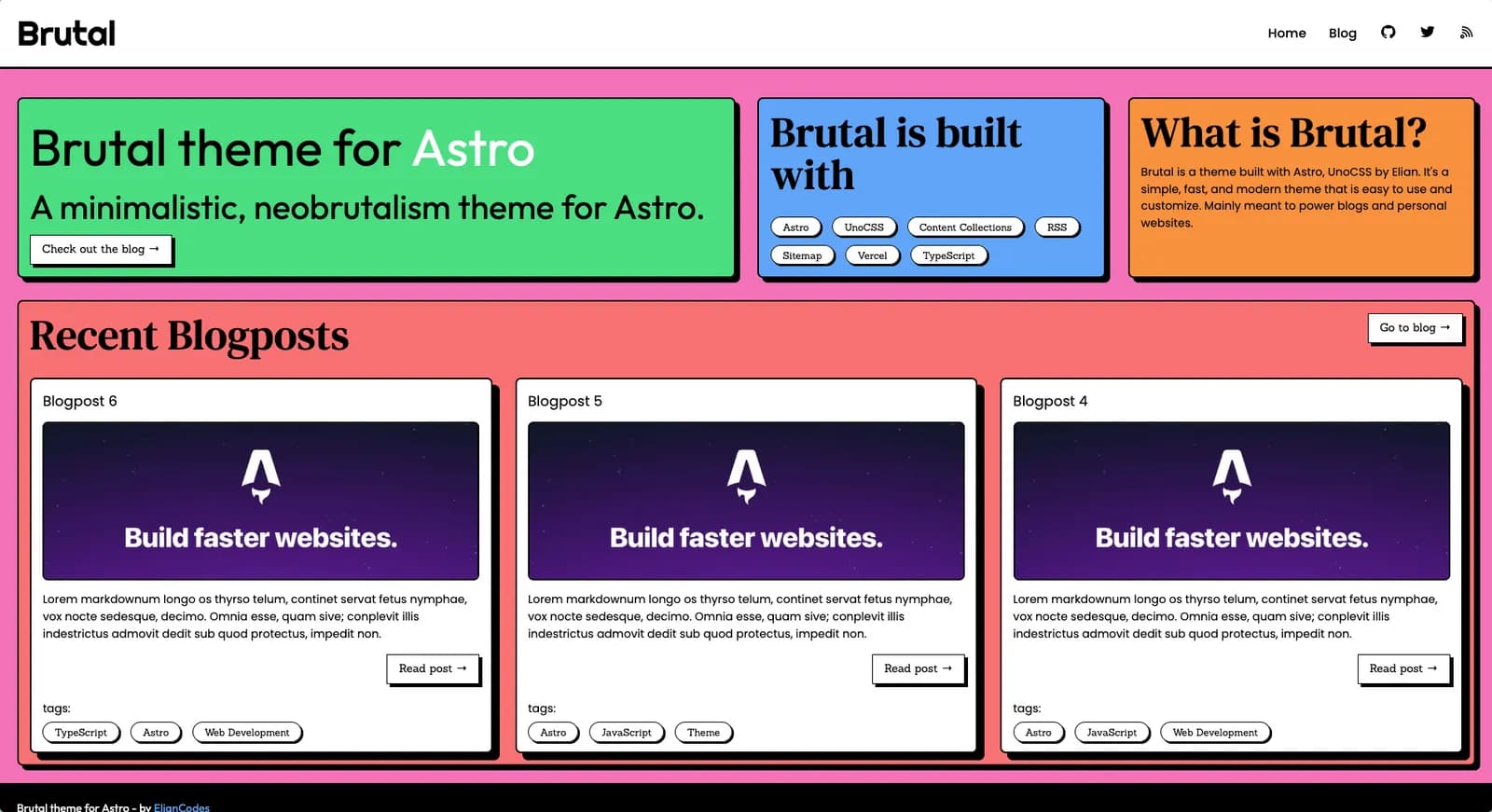
Brutal - The neobrutalist Astro theme
Brutal is a minimal neobrutalist theme for Astro. It's based on Neobrutalist Web Design, a movement that aims to create websites with a minimalistic and functional design. It has some integrations like Image Optimization, RSS, Sitemap, ready to get your SEO done right.
The theme has no JavaScript integration out of the box, but can always be added of course.
This template is based on my own personal website, with some more generic things added.
Usage
You can bootstrap a new Astro project using Brutal with the following command:
Commands
All commands are run from the root of the project, from a terminal:
(Here I use PNPM, no problem if you use NPM or Yarn)
| Command | Action |
|---|---|
pnpm install | Installs dependencies |
pnpm dev | Starts local dev server at localhost:4321 |
pnpm lint | Runs Biome lint checks |
pnpm format | Formats the project with Biome |
pnpm check | Runs Astro checks plus biome check |
pnpm build | Build your production site to ./dist/ |
pnpm preview | Preview your build locally, before deploying |
pnpm astro ... | Run CLI commands like astro add, astro preview |
pnpm astro --help | Get help using the Astro CLI |
Tooling
This project uses Biome for formatting, linting, and import organization.
Astro-specific diagnostics still run through astro check, so CI and local validation use both:
Integrations
Tailwind CSS
In this theme, I'm using Tailwind CSS to generate the utility classes. The project uses Astro's Tailwind setup with the Vite plugin, plus a small amount of regular CSS for the theme-specific scrollbar and shadow styling.
Sitemap
To generate the sitemap, you don't need to do anything. It's automatically generated when you build your site. You'll just need to switch out the site on astro.config.ts to your own.
RSS
The RSS feed is automatically generated from the Markdown files in the src/content/blog folder. You can ofcourse completely change this to your own needs.
The RSS will output to https://example.com/feed.xml by default. You can change this, by renaming src/pages/feed.xml.js.
Image
Components
components/blog/
This directory contains all components for the blog.
components/errors/
This directory contains all error components.
components/errors/404.astro
This component is used when a page is not found.
components/generic/
This directory contains all generic components, reused over multiple pages.
components/home/
This directory contains all components for the home page.
components/layout/
This directory contains all layout components. For instance, the header and footer and <head> section.
If you need more from this theme, don't hesitate to open an issue or reach out to me!


